
How WaterPave permeable concrete is installed
WaterPave is a patented, single-pour permeable concrete, placed by trained installers on a free-draining sub-base. Here’s each load spec, how a project runs from first call to final inspection, and the numbers behind it.
Concrete that lets the rain through: how it’s installed.
WaterPave is a patented, single-pour permeable concrete. Its admixtures lock the stone together, and every build-up is matched to the loads it carries and how fast the ground drains. Here’s how a WaterPave project runs, from first call to final inspection.
- 30,000+ mm/hinfiltration rate, tested to ASTM C1701
- 21–32 MPatypical compressive strength
- 20%connected voids
- 50+ yearsstructural design life

Four specs, matched to the load.
Pick what the surface has to carry. Typical depths from WaterPave’s specifications; final depths are confirmed for each site.
The finished surface: stone locked together with cement and WaterPave admixtures. Rain passes through its open voids while it carries the load.
- Depth
- 100 mm
- Use
- Garden paths, public footpaths and landscaped areas with foot traffic only
At least 35% voids. It supports the slab and holds water while it soaks away.
- Depth
- Confirmed for each site
Water returns to the soil and tops up groundwater. The design is matched to how fast your soil drains.
The finished surface: stone locked together with cement and WaterPave admixtures. Rain passes through its open voids while it carries the load.
- Depth
- 125 mm
- Use
- Standard vehicles and domestic driveways
At least 35% voids. It supports the slab and holds water while it soaks away.
- Depth
- 125 mm on the driveway spec
Water returns to the soil and tops up groundwater. The design is matched to how fast your soil drains.
The finished surface: stone locked together with cement and WaterPave admixtures. Rain passes through its open voids while it carries the load.
- Depth
- 150 mm
- Use
- Access lanes and commercial car parks that need more load capacity
At least 35% voids. It supports the slab and holds water while it soaks away.
- Depth
- Confirmed for each site
Water returns to the soil and tops up groundwater. The design is matched to how fast your soil drains.
The finished surface: stone locked together with cement and WaterPave admixtures. Rain passes through its open voids while it carries the load. Macro fibre is an option for heavier applications.
- Depth
- 300 mm
- Use
- Heavy rigid vehicles, permeable roads and emergency vehicles
At least 35% voids. It supports the slab and holds water while it soaks away.
- Depth
- Confirmed for each site
Water returns to the soil and tops up groundwater. The design is matched to how fast your soil drains.
From first call to final inspection.
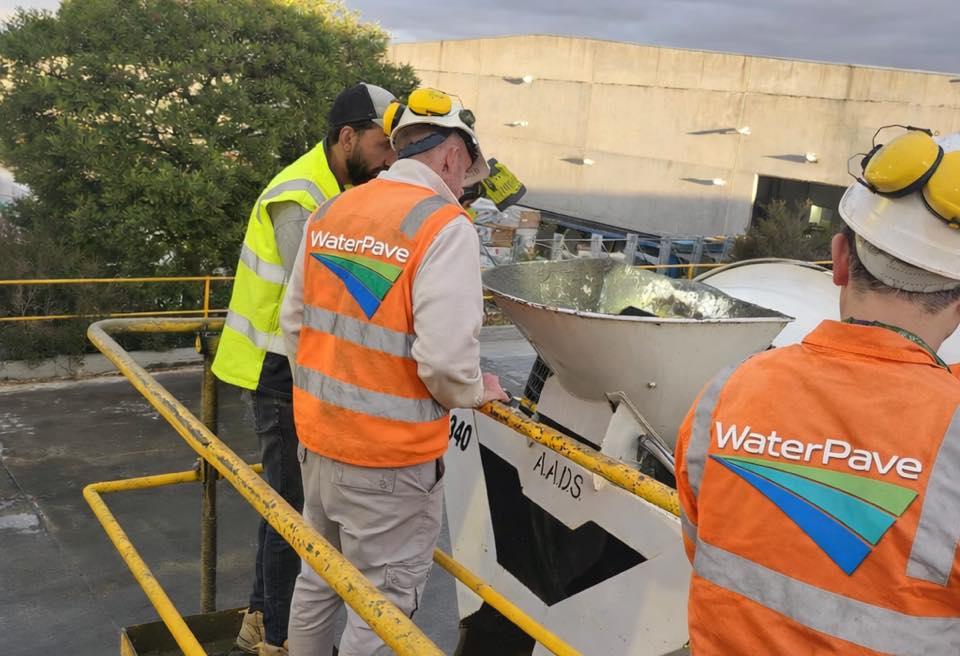
WaterPave is placed and finished by trained installers. Here’s each stage of the job.
- 1
Consultation
Tell us what the project is, where it is and roughly how big. A rough size is fine to start.
TipPlanning a front garden or a large site? Our site prep guide covers drainage rules and what decides the build-up.
- 2
Site inspection and proposal
The site is inspected, and you receive a proposal with the build-up for your ground and loads: the depth of the wearing course and the sub-base, matched to how fast your soil drains.
- 3
The sub-base
A free-draining sub-base of compacted stone screenings, with at least 35% voids, goes down over the natural ground. It supports the slab and holds water while it soaks away.
- 4
The single pour
WaterPave is a single-pour system. Trained installers place and finish the surface to the depth in your proposal: typically 100 mm for pedestrian areas, 125 mm for driveways, 150 mm for commercial access lanes and car parks, and 300 mm for heavy duty.
TipChoose from seven standard colours, with custom variations on request.
- 5
Fit-out
It fits out like any car park. Standard line-marking paint, cat’s-eye reflectors, safety bollards and permanent concrete wheel stops all fix straight onto the surface.
TipAn approved clear sealer can be applied after installation.
- 6
Completion
A final inspection, plus guidance on looking after your surface.
TipOur care guide covers sweeping, keeping the voids clear and cleaning.
The numbers behind it.
WaterPave’s published test data. Typical values, given for guidance.
Permeable
30,000+ mm/h surface infiltration, tested to ASTM C1701: about 8.3 litres through every square metre, every second.
Strong
21–32 MPa typical compressive strength, by mix design.
Open
20% voids: a connected network for water and air.
Sure-footed
P5 wet rating, pendulum value 88, to AS 4586-2013.
Long-lived
50+ years structural design life, from an engineer’s car park review.
Load-bearing
Up to 10 t on the standard installation, more on request.
Source: WaterPave Australia technical data sheet TDS001, October 2026. How quickly water leaves the whole build-up depends on the sub-base and the ground beneath. Confirm suitability and design for your project before specifying.
Real spaces, real impact.
Pick a setting.
Driveways
A clean, modern driveway that drains as it rains, with no puddles at the front door.
Garden paths and patios
Paths and patios that stay usable in wet weather.
Pool surrounds
Splash water drains straight through, and the surface carries a P5 wet slip rating.
Car parks
Hard-wearing parking that manages stormwater across large areas. Lines, bollards and wheel stops fit as normal.
Access lanes
Entrances and service lanes built for regular vehicle loads.
Footpaths and cycleways
Less standing water and fewer slippery puddles.
Tree pits
Paving right up to the trunk, while water and air still reach the roots.
Roads
Light-vehicle roads, crossovers and laneways, designed around the loads they carry, up to heavy duty for emergency vehicles.
More in the WaterPave guide series
Questions we get asked
What is WaterPave?
A permeable concrete: a rigid surface with a connected network of open voids, so rain passes through into a free-draining sub-base and on into the ground. Its admixtures lock the stone together, which sets it apart from standard no-fines porous concrete.
How fast does it drain?
Over 30,000 mm an hour at the surface, tested to ASTM C1701. How quickly water leaves the whole build-up depends on the sub-base and the ground beneath.
How thick is it?
Typically 100 mm for pedestrian areas, 125 mm for driveways, 150 mm for commercial access lanes and car parks, and 300 mm for heavy duty. Final depths are confirmed for each site.
What loads can it take?
Up to 10 t on the standard installation, more on request. The heavy-duty spec is designed for heavy rigid vehicles, permeable roads and emergency vehicles.
Is it slippery when wet?
It has a P5 wet rating, with a pendulum value of 88 to AS 4586-2013.
What colours are there?
Seven standard colours, with custom variations on request. Ask for a physical sample before you choose.
Keep reading
All news & guides One factory, every surface: which Infinity system?Which Infinity system for your project? Pick the surface, from worktops and kitchen doors to floors, walls, driveways, uPVC and furniture, and see the system.26 Nov 2026 · 4 min readRead the guide
 Start a coatings business with InfinityHow to start a coatings business with Infinity Effects: pick your services, train and certify, open a trade account, get found and grow.26 Nov 2026 · 3 min readRead the guide
 How to order from Infinity EffectsHow to order from Infinity Effects: set up your account, build your kit list, check out and choose delivery, with dispatch times and where we ship.26 Nov 2026 · 3 min readRead the guide