R.S.P Polyaspartic vs 2K paint and epoxy resin
How the Infinity Effects R.S.P range compares on worktops, floors and decorative pours: in the cold, against the clock, in sunlight and on site.
Three chemistries, one clear winner for decorative work.
R.S.P is the Infinity Effects decorative pour polyaspartic range: a primer, a base coat and a topcoat that roll, spray, trowel or pour into seamless worktops, vanity tops and floors. It replaces older resin systems that yellow, crack and lose flexibility. Here is how it compares with the two systems it is most often measured against.
| R.S.P Polyaspartic | 2K PU paint | Epoxy resin | |
|---|---|---|---|
| Chemistry | Hybrid polyaspartic | Two-pack polyurethane paint | Two-pack epoxy resin |
| Cold weather | Cures without added heat. Cold slows it, but it still completes | Many need 15–18°C or more while curing | Most won’t fully cure below 10°C |
| Ready for use | Traffic after 6–8 h (Fast Set) · 48 h (Slow Set) | Final cure about 10 days at 20°C | Foot traffic about 12–24 h · full cure about 7 days |
| Recoat window | From 20 minutes, up to 12 hours | Varies by product | About 8–24 h at 20°C |
| Solvent | 100% solids, solvent-free | Solvent-borne, about 420–450 g/L VOC | Varies: solvent-free to solvent-borne |
| Sunlight | 100% UV stable | Depends on the formulation | Shifts colour in UV |
| Film per coat | About 0.1 mm rolled, 0.7 mm poured | About 25–30 µm dry per coat | Depends on the grade |
| Movement | Flexible for heat-exposed areas and slight movement | Thin film follows the substrate | Rigid once cured |
| Application | Roll, spray, trowel or pour | Mostly sprayed, in thin coats | Roll, trowel or pour |
| Looks | One to three colour pours from POLY and RAL; gloss, satin or matt | Solid colours | Solid, flake and metallic effects |
R.S.P: infinityeffects.com product pages, Nov 2026. 2K paint and epoxy: typical values from published data sheets (Hempel, Remmers, ColorWest, Derisol, Sika, Euclid Chemical); they vary by product. Always follow the data sheet for the product you use.
Fit it in the cold. No heaters.
Polyaspartic chemistry keeps reacting when it is cold. A lower temperature slows the cure, but unlike epoxy the reaction still completes. That means R.S.P can go down in unheated garages, outbuildings and winter jobs without heaters, warming boxes or a warm spray booth.
Typical minimum temperature to apply and cure
The coloured bar is the usable range, from the lowest temperature on typical data sheets upwards.
Epoxy slows sharply in the cold
Rule of thumb: cure time doubles for every 10°C drop.
may never cure
Needs warmth to cure
Most epoxies never fully cure below 10°C unless they are made for the cold. Cold, damp conditions can also leave amine blush: a greasy white film that weakens adhesion and dulls the gloss.
Needs a warm room
Typical 2K polyurethane data sheets ask for 15–18°C or more through application and cure, and many are force-dried at around 60°C.
No heaters needed. R.S.P cures in cold, unheated spaces.
Fast Set gels in about 20 minutes at 15°C, and quicker when warm. Keep it for small areas and quick turnarounds.
Slow Set gels in about 2 hours. Use it for medium to large areas and decorative pours.
Need more working time? Heat speeds the cure; add Infinity Work Time Extender.
Polyaspartic cold cure: Coatings Pro Magazine, “Temperature effects on installing epoxies” (2021); cold-set polyaspartic example: Watco Cold Set Coating, applied between −10°C and +30°C. Epoxy: Euclid Chemical cold-weather guidance; amine blush below 10°C. 2K PU: Hempel Hempathane Fast Dry (surface above 15°C), Remmers PUR paints (18°C for 48 h), Teknos (forced drying at 60°C). R.S.P set times: infinityeffects.com.
Prime, pour, coat and use it the same day.
R.S.P Fast Set is dry in about 2 hours and ready for traffic after 6–8 hours, and each coat can be recoated from 20 minutes. A full countertop system can go down and be back in use in one working day. Epoxy and 2K paint ask for days, not hours.
Time until ready for normal use, at about 20°C
R.S.P figures are the recommended times before traffic or use. Epoxy and 2K figures are full-cure times from typical data sheets; the white tick marks first light use.
A typical install day
R.S.P Fast Set: primer overcoated once tacky (15 min), base coat dry in 2 h, topcoat on, traffic 6–8 h later. Epoxy: second coat after at least 8 h, foot traffic about 12 h after that.
R.S.P Fast Set and Slow Set times: infinityeffects.com (R.S.P Poly Base Coat and Topcoat). Epoxy: Sika Sikafloor-264 (foot traffic ~12 h, full cure ~7 days, recoat 8–24 h at 20°C). 2K PU: ColorWest 2K polyurethane topcoat (workable 6 h, final cure 10 days at 20°C). Times vary with temperature, humidity and film thickness.
More film per coat. Nothing to flash off.
R.S.P is 100% solids, so everything you put down stays down. One rolled coat builds roughly the film of three or four coats of 2K paint, and a pour builds far more, with no solvent evaporating into the room.
Dry film per coat
R.S.P calculated from the stated coverage (≈10 m²/kg rolled, ≈1.4 m²/kg poured) and density (1.06 kg/L) at 100% solids. 2K: 50 µm wet at about 55% volume solids.
Solvent in the mixed product, by weight
100% UV stable
R.S.P keeps whites white and colours true near windows and outdoors. Epoxy is known to shift colour in UV, so it needs a UV-stable topcoat where light reaches it.
Flexible and hard-wearing
Flexible enough for areas exposed to heat and slight structural movement, with superior scratch and abrasion resistance and excellent chemical resistance.
Gloss, satin or matt
High gloss from R.S.P Poly Topcoat, or satin and matt with an R.S Urethane overcoat. Slip resistance can be customised.
Solvent-free, low VOC
Formulated using CO₂ by-products and recycled materials, with no solvents to vent.
R.S.P: infinityeffects.com (100% solids, solvent-free, density and coverage, UV stability, flexibility, finishes, CO₂ by-products). 2K PU: ColorWest (50 µm wet, ≈55% volume solids, ≈450 g/L VOC); Derisol 2K (≈420 g/L VOC, solvent ≈33–36% by weight). Epoxy UV colour shift: published product literature.
Every layer, one system.
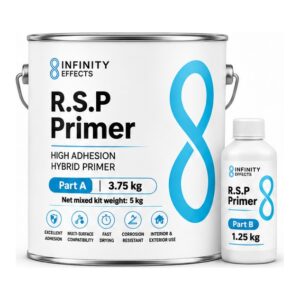
R.S.P Primer
3:1The first step of every R.S.P system. A solvent-free hybrid epoxy primer that leaves a tacky surface for the pour to grip, and can act as a moisture vapour barrier on suitable prepared concrete.
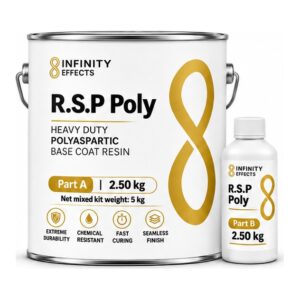
R.S.P Poly Base Coat
1:1The decorative layer where the design is created. Clear or pigmentable, poured in one, two or three colours from the POLY and RAL ranges.
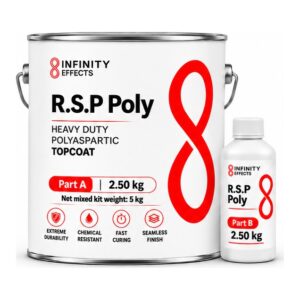
R.S.P Poly Topcoat
1:1A crystal-clear, high-gloss, self-levelling coat that protects and deepens the design, with an advanced UV-stabiliser package.
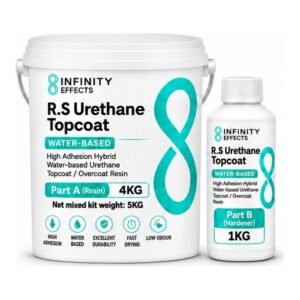
R.S Urethane Topcoat
4:1Optional overcoat that changes the final sheen to satin or matt and adds extra protection.
PolyFuse MAX
4:1Flexible filler for cracks and voids before priming. Suitable from −25°C.

P.HB Poly Screed
4:1:1Screed base that levels and strengthens uneven or ungrindable concrete before the pour.
Fast Set or Slow Set: same price, your pace
R.S.P Poly Base Coat and Topcoat
| FAST SET | SLOW SET | |
|---|---|---|
| Gel time | 20 minutes (at 15°C) | 2 hours |
| Dry | 2 hours | 24 hours (full dry) |
| Ready for use | Traffic after 6–8 hours | 48 hours recommended |
| Recoat window | 20 minutes to 12 hours | 20 minutes to 12 hours |
| Best for | Small areas, quick return to service | Medium to large areas and decorative pours |
Take care with Fast Set on medium to large areas: its working time is short, and shorter still in warm conditions.
All product details: infinityeffects.com R.S.P product and system pages, Nov 2026. Coverage depends on the surface and method; check the Technical Data Sheet before each job.
Pick a system. We’ll train you on it.
Worktops and islands in busy homes and commercial kitchens. Four layers.
R.S Urethane (optional)R.S.P Poly TopcoatR.S.P Poly Base CoatR.S.P PrimerSubstrateSee the systemFloor System 1Screed-based: levels and strengthens the floor first. Seven layers.
R.S Urethane (optional)R.S.P Poly TopcoatR.S.P Poly Base CoatR.S.P PrimerP.HB Poly ScreedAdhesiMeshR.S.P PrimerSubstrateSee the systemFloor System 2Straight onto existing, properly prepared concrete. Four layers.
R.S Urethane (optional)R.S.P Poly TopcoatR.S.P Poly Base CoatR.S.P PrimerSubstrateSee the systemFor most decorative work
Cold or unheated spaces, same-day return to service, decorative pours that must stay colour-true in sunlight, and solvent-free installs indoors.
Thin-film colour resprays
Where film build is not needed and a warm, ventilated spray area is available for the full cure.
Warm, controlled interiors
Where there is time to cure, the room stays above 10°C, and UV exposure is not a concern.
System build-ups: infinityeffects.com R.S.P Countertop System 1, Floor System 1 and Floor System 2. Comparisons with 2K paint and epoxy use typical published values and vary by product; this guide does not replace the Technical Data Sheet.
Questions we get asked
Can R.S.P go down in a cold, unheated garage?
Yes. Polyaspartic chemistry keeps reacting in the cold: a lower temperature slows the cure, but it still completes, so there is no need for heaters, warming boxes or a warm spray booth. Fast Set gels in about 20 minutes at 15°C.
How soon can a worktop or floor be used?
With R.S.P Fast Set, traffic is recommended after 6–8 hours, so a full countertop system can go down and be back in use in one working day. With Slow Set, allow 48 hours before use.
Should I use Fast Set or Slow Set?
They are the same price. Fast Set suits small areas and quick turnarounds. Slow Set gels in about 2 hours and suits medium to large areas and decorative pours. Take care with Fast Set on larger areas: its working time is short, and shorter still when it is warm.
Will R.S.P yellow in sunlight?
R.S.P is 100% UV stable, so whites stay white and colours stay true near windows and outdoors. Epoxy is known to shift colour in UV and needs a UV-stable topcoat where light reaches it.
Can I get a satin or matt finish?
Yes. R.S.P Poly Topcoat gives a high-gloss finish. Overcoat it with R.S Urethane Topcoat for satin or matt, and extra protection.
Keep reading
All news & guides Spray Granite vs replacing your worktopsSpray Granite or new worktops? Cost, time, mess, finish and warranty compared, with a cost calculator and real before-and-after jobs from our fitters.26 Nov 2026 · 8 min readRead the guide
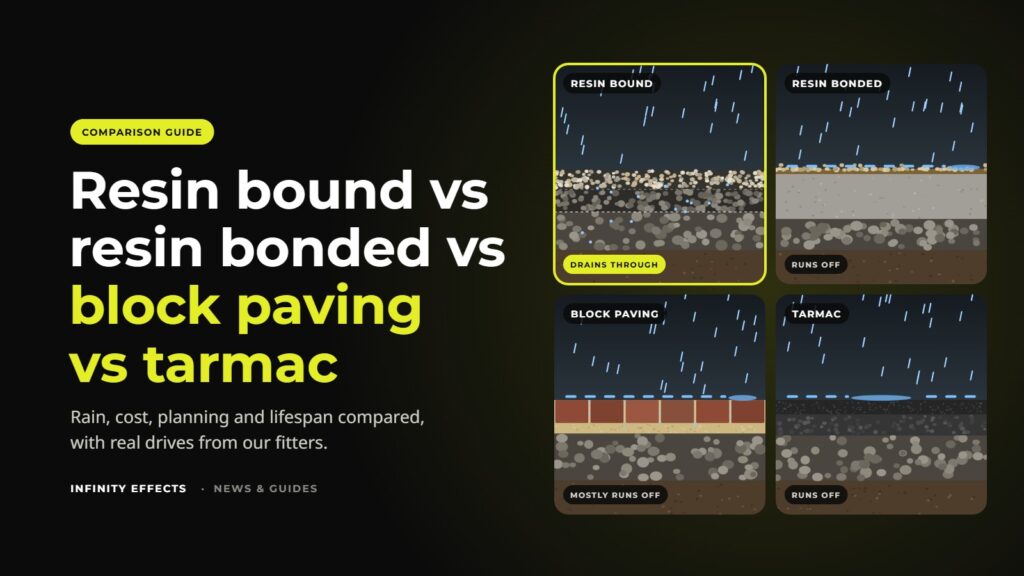 Resin bound vs resin bonded vs block paving vs tarmacResin bound, resin bonded, block paving or tarmac? Drainage, planning, cost, looks and lifespan compared, with a planning checker, a cost calculator and real drives from our fitters.26 Nov 2026 · 8 min readRead the guide