How to respray with R.S Urethane: kitchens, uPVC, timber and metal
R.S Urethane resprays kitchens, uPVC, timber and metal with the same coats. Here’s each build-up, every step from strip-down to refit, the timings and how much you’ll need.
Kitchens, uPVC, timber and metal: one respray system.
R.S Urethane is a two-part, water-based hybrid urethane respray in 1,000+ colours. The coats are the same on every surface. What changes is the prep, and whether you need the blocking primer.
- 4systems: uPVC, kitchens, timber, metal
- ≈ 15 m²per kg per coat of Primer / Base Coat
- 30 min–36 hrecoat window
- 24 h · 3–5 dayslight use · full cure on kitchens
Pick your surface, see every coat.
Every respray goes prep, blocking primer if needed, colour, then an optional clear topcoat. Tap a layer for the product, coverage and timings.
Removed, numbered, cleaned with warm water and degreaser, rinsed and dried. Failed vinyl removed, repairs filled and sanded, the rest keyed to remove the gloss.
- Repairs
- 120–180 to shape, 220–240 to smooth, 320–400 to finish
- Keying
- 220–400 grit or Scotchbrite
A two-part 4:1 high-build water-based urethane primer in white, for bare MDF, stains and patches. Thick by design: let it dry, then sand it flat where you need a flat finish, such as over MDF.
- Coverage
- About 10 m² per kg per coat on sealed surfaces
- Porous
- Bare MDF and timber take about twice as much, in two coats
- Dry at 25 °C
- Touch dry 1 hour, fully dry 3 hours
- Spray
- 2–3 bar, 1.2–2.0 mm nozzle; or roll it
A two-part 4:1 hybrid water-based urethane in White, Black and 1,000+ colours, in gloss, satin or matt. Pour all of Part B into Part A and mix for 2–3 minutes with a slow-speed drill and paddle. Thin with DI water only, if needed.
- Coverage
- About 15 m² per kg per coat
- Recoat
- From 30 minutes once touch dry; lightly abrade after 36 hours
- Spray
- HVLP or turbine, 1.2–1.8 mm nozzle, filtered at 190 micron
A crystal-clear 4:1 topcoat in gloss, satin or matt, for extra protection. Mixed and applied like the colour coat.
- Coverage
- About 15 m² per kg per coat
Cleaned with a silicone-free degreaser, rinsed and dried, sanded lightly only where needed, then misted with Fusion Degreaser / Adhesion Promoter, wiped evenly and left to dry.
- Sanding
- 240–400 grit or finer, where needed. Don’t over-sand
A two-part 4:1 high-build water-based urethane primer in white, for stained or patched frames. Thick by design: let it dry, then sand it flat where you need a flat finish, such as over MDF.
- Coverage
- About 10 m² per kg per coat on sealed surfaces
- Porous
- Bare MDF and timber take about twice as much, in two coats
- Dry at 25 °C
- Touch dry 1 hour, fully dry 3 hours
- Spray
- 2–3 bar, 1.2–2.0 mm nozzle; or roll it
A two-part 4:1 hybrid water-based urethane in White, Black and 1,000+ colours, in gloss, satin or matt. Pour all of Part B into Part A and mix for 2–3 minutes with a slow-speed drill and paddle. Thin with DI water only, if needed.
- Coverage
- About 15 m² per kg per coat
- Recoat
- From 30 minutes once touch dry; lightly abrade after 36 hours
- Spray
- HVLP or turbine, 1.2–1.8 mm nozzle, filtered at 190 micron
A crystal-clear 4:1 topcoat in gloss, satin or matt, for extra protection. Mixed and applied like the colour coat.
- Coverage
- About 15 m² per kg per coat
Keyed, dust removed and degreased. Bare timber and boards are porous.
A two-part 4:1 high-build water-based urethane primer in white, for knots, tannins and bare boards. Thick by design: let it dry, then sand it flat where you need a flat finish, such as over MDF.
- Coverage
- About 10 m² per kg per coat on sealed surfaces
- Porous
- Bare MDF and timber take about twice as much, in two coats
- Dry at 25 °C
- Touch dry 1 hour, fully dry 3 hours
- Spray
- 2–3 bar, 1.2–2.0 mm nozzle; or roll it
A two-part 4:1 hybrid water-based urethane in White, Black and 1,000+ colours, in gloss, satin or matt. Pour all of Part B into Part A and mix for 2–3 minutes with a slow-speed drill and paddle. Thin with DI water only, if needed.
- Coverage
- About 15 m² per kg per coat
- Recoat
- From 30 minutes once touch dry; lightly abrade after 36 hours
- Spray
- HVLP or turbine, 1.2–1.8 mm nozzle, filtered at 190 micron
A crystal-clear 4:1 topcoat in gloss, satin or matt, for extra protection. Mixed and applied like the colour coat.
- Coverage
- About 15 m² per kg per coat
Cleaned into every corner and joint, abraded with 220–400 grit or a suitable pad, then misted with Fusion Degreaser / Adhesion Promoter and left to dry fully.
- Non-ferrous
- Aluminium, galvanised steel and zinc
A two-part 4:1 high-build water-based urethane primer in white, for stains or rust marks that show through. Thick by design: let it dry, then sand it flat where you need a flat finish, such as over MDF.
- Coverage
- About 10 m² per kg per coat on sealed surfaces
- Porous
- Bare MDF and timber take about twice as much, in two coats
- Dry at 25 °C
- Touch dry 1 hour, fully dry 3 hours
- Spray
- 2–3 bar, 1.2–2.0 mm nozzle; or roll it
A two-part 4:1 hybrid water-based urethane in White, Black and 1,000+ colours, in gloss, satin or matt. Pour all of Part B into Part A and mix for 2–3 minutes with a slow-speed drill and paddle. Thin with DI water only, if needed.
- Coverage
- About 15 m² per kg per coat
- Recoat
- From 30 minutes once touch dry; lightly abrade after 36 hours
- Spray
- HVLP or turbine, 1.2–1.8 mm nozzle, filtered at 190 micron
A crystal-clear 4:1 topcoat in gloss, satin or matt, for extra protection. Mixed and applied like the colour coat.
- Coverage
- About 15 m² per kg per coat
The respray, one step at a time.
These steps follow our kitchen, uPVC and metal application guides. The prep and troubleshooting guide covers each surface in more detail.
- 1
Inspect and strip down
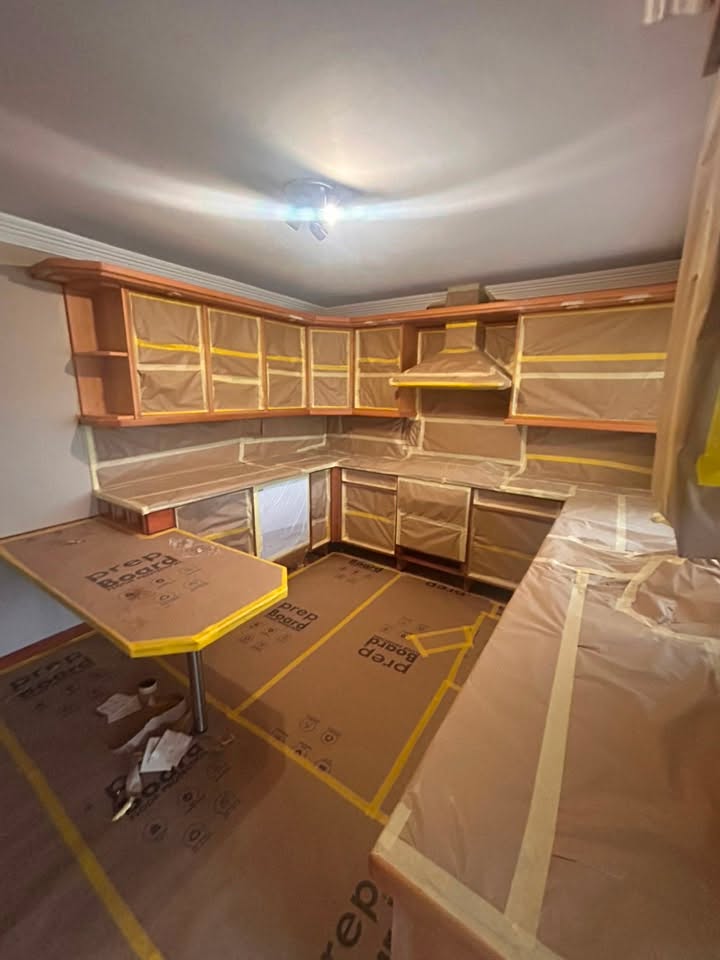
Check for damage, scratches, dirt, silicone and failed or unsuitable coatings, and don’t carry on over anything greasy, wet, unstable or poorly bonded. On kitchens, take off doors, drawer fronts, plinths and removable end panels, plus handles, hinges and shelf pins. Number each door discreetly with its carcass position, and bag and label the hardware.
- Bags and labels
- 2
Clean and degrease
Wash with warm water and a degreaser, rinse thoroughly and dry with lint-free microfibre until completely dry.
TipNever use silicone-containing cleaners, and keep silicone products away from the spray area.
- Degreaser
- Lint-free microfibre
- 3
Repair and key
Remove failed or lifting vinyl. Fill damage and sand it: 120–180 to shape, 220–240 to smooth, 320–400 to finish. Key the rest with 220–400 or Scotchbrite to remove the gloss. On uPVC, sand lightly with 240–400 only where needed. Then remove every trace of dust: vacuum and tack-cloth.
TipDon’t over-sand uPVC.
- 120–400 abrasives
- Red/grey Scotchbrite
- MDF or 2-part filler
- Tack cloths
- 4
Mask
Mask worktops, appliances, glass, seals, gaskets, hinges, drainage channels and surrounding surfaces. Press the tape firmly into corners and profiles, and use film or sheeting for larger areas.
- Masking tape
- Masking film
- 5
Promote adhesion, where required
On uPVC, metal and other difficult surfaces, mist on Fusion Degreaser / Adhesion Promoter, wipe or distribute it evenly, and let it dry fully.
TipNever coat over wet promoter.
- Fusion Degreaser / Adhesion Promoter
- 6
Block, where needed
1 h touch dryOver bare MDF, knots, tannins, stains or patches, apply R.S Urethane High Build Blocking Primer: spray at 2–3 bar with a 1.2–2.0 mm nozzle, or roll it. At 25 °C it’s touch dry in 1 hour and fully dry in 3. It’s thick by design, so sand it flat where you need a flat finish. Bare MDF and timber take a second coat.
- Spray gun or roller
- Fine abrasives
- 7
Mix the colour
Stir Part A until uniform. If you need to adjust the viscosity, add up to 10–15% DI water to Part A only. Add Part B (the mix is 4:1 by weight) and mix for 2–3 minutes with a slow-speed drill and paddle, then filter through 190 micron into the spray cup. On jobs using several kits, combine and mix the Part A from all of them first, so the colour matches.
TipFor a faster cure when spraying, add R.S Urethane Catalyst to Part A before Part B, at 0.1–2% of the total mixed kit weight: less when it’s warm, more when it’s cold. Never exceed 2%, trial it first and use it straight away. It’s for spraying only, not rolling.
- Slow-speed drill and paddle
- 190 micron filters
- DI water
- 8
Test, then spray
Spray a test panel to confirm the colour, viscosity, settings and finish. Then do corners, profiles, recesses and edges first and the main faces after, in controlled, overlapping passes at a steady distance, angle and speed. Light coats avoid runs and sags.
TipOur uPVC and metal guides spray the colour at 3–4 bar with a 1.2–1.8 mm nozzle.
- HVLP gun or turbine
- 1.2–1.8 mm nozzle
- 9
Build the coats
30 min to 36 hRecoat once each coat is touch dry, from 30 minutes; on kitchens that’s typically 1–2 hours, depending on conditions. Add coats until the colour is fully opaque. After 36 hours, lightly abrade before the next coat.
TipRecoating too soon can cause whitening or hazing.
- 10
Topcoat (optional)
For extra protection, apply R.S Urethane Topcoat in gloss, satin or matt, mixed and sprayed the same way.
- 11
Cure, then refit
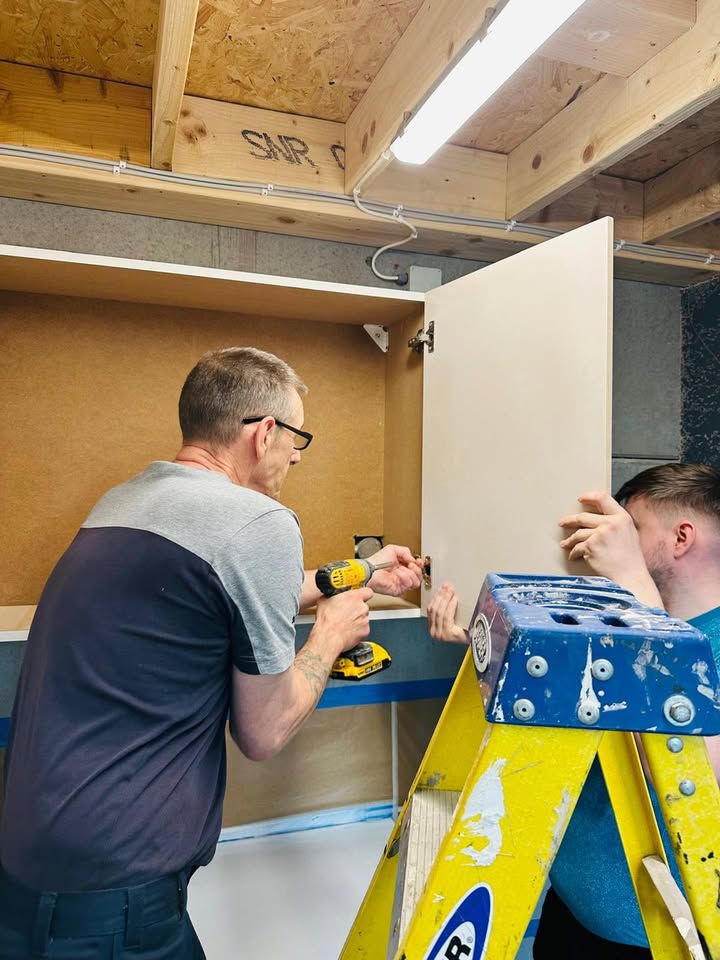
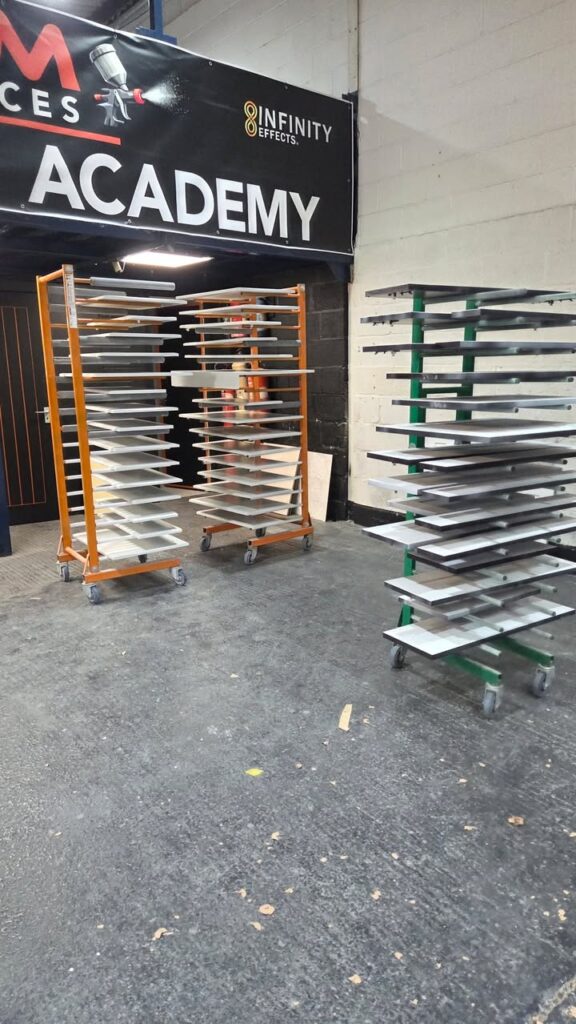
24 h · 3–5 daysLeave the work undisturbed: no stacking, no coated edges touching, no moisture and no early refitting of hardware. Kitchens are ready for light use after 24 hours and fully cured in 3–5 days, depending on conditions. Remove masking carefully for clean edges.
- Drying racks
Recoat, use, cure: the timings.
Drag the slider from the moment each coat goes on.
- 1 hourTouch dry
- 3 hoursFully dry: sand flat where needed
- 30 minEarliest recoat, once touch dry
- 1–2 hoursTypical recoat on kitchens
- 24 hoursLight use (kitchens)
- 36 hoursRecoat window: lightly abrade after this
- 3–5 daysFull cure (kitchens)
Temperature, humidity and airflow all change drying and cure times. The catalyst can speed up the cure when you’re spraying.
How much you’ll need.
A quick estimate from our coverage figures. Build Your R.S Urethane System gives your exact kit list and prices.
Use the builder for your exact kit list. Build your R.S Urethane system
R.S Urethane on real jobs.
Kitchens and doors resprayed by our fitters.
More in the R.S Urethane guide series
Questions we get asked
What can R.S Urethane respray?
uPVC and PVC windows, doors and fascias; kitchen doors and drawer fronts, including laminate, vinyl-wrapped, gloss, painted, MDF and melamine; painted, varnished or bare timber, MDF, plywood and chipboard; and galvanised, powder-coated, painted or bare metal, including aluminium and zinc.
Do I need the blocking primer?
Only where needed: bare MDF, timber with knots or tannins, stains, patches, or rust marks that keep showing through. uPVC and metal rarely need it.
What’s the mix ratio?
4:1 by weight, Part A to Part B, for the blocking primer, Primer / Base Coat and Topcoat. Thin with DI water only, if you need to.
Can I roll or brush it instead of spraying?
Yes. Primer / Base Coat and Topcoat can be brushed, rolled or sprayed. The catalyst is for spraying only.
How soon can a resprayed kitchen be used?
Light use after 24 hours, and full cure in 3–5 days, depending on conditions. Don’t refit hardware or stack doors too early.
What colours are there?
White, Black and 1,000+ INFI and RAL colours, in gloss, satin or matt. RAL colours come in 5 kg kits, tinted free on our in-house tinting machine.
Keep reading
All news & guides One factory, every surface: which Infinity system?Which Infinity system for your project? Pick the surface, from worktops and kitchen doors to floors, walls, driveways, uPVC and furniture, and see the system.26 Nov 2026 · 4 min readRead the guide
 Start a coatings business with InfinityHow to start a coatings business with Infinity Effects: pick your services, train and certify, open a trade account, get found and grow.26 Nov 2026 · 3 min readRead the guide
 How to order from Infinity EffectsHow to order from Infinity Effects: set up your account, build your kit list, check out and choose delivery, with dispatch times and where we ship.26 Nov 2026 · 3 min readRead the guide