Infi-Rox base prep and troubleshooting
Most resin bound problems start in the base. Here’s how to check and prepare concrete, tarmac, a new SuDS base, internal floors and walls, when to lay, and how to fix the problems that show up most.
A resin bound surface is only as good as the base under it.
Infi-Rox goes over sound concrete or tarmac, onto a new permeable SuDS base, indoors as a stone carpet, or up a wall. Here’s how to check and prepare each base, the weather to lay in, and how to fix the problems that show up most.
- < 6%moisture in concrete before priming
- 25 MPa+recommended concrete strength
- 1:60–1:80falls on a new SuDS base
- 10–25 °Cideal laying range
Is today a good day to lay?
Set the temperature to check, and tick the box if the base is damp or rain is forecast.
Lay between 5 °C and 30 °C, ideally 10–25 °C. Avoid direct sun, high winds, frost and rain, and don’t start if rain is forecast.
Lay between 5 °C and 30 °C, ideally 10–25 °C. Avoid direct sun, high winds, frost and rain, and don’t start if rain is forecast.
Dew point
Monitor temperature, humidity and dew point through the job.
Dry, stable materials
Keep resin and stone at a stable temperature, and the stone completely kiln-dried.
Shelter
A mixing tent and a forced-air heater help on cold or changeable days.
Getting the base ready to prime.
Pick what you’re laying on.
Check it
Clean, dry, structurally sound and free from contamination, with moisture below 6% and pH below 10. 25 MPa or more is recommended. Never lay onto damp or green concrete.
Repair it
Look for cracks, spalled or loose material, depressions, movement joints and weak or powdery concrete. Fill cracks with repair mortar and grind high spots.
Open it up
Mechanically abrade or diamond-grind where needed for a clean, open profile, then vacuum. Mask walls, edging, drain covers and doors.
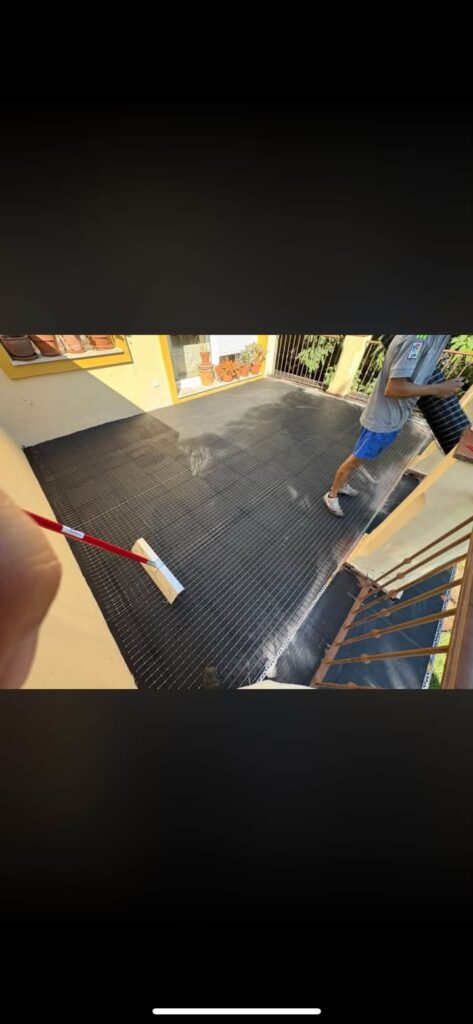
Existing tarmac is treated like concrete: it has to be sound, clean and dry.
ROX Concrete Primer is optional on tarmac, and CRM Mesh is recommended to bridge movement.
Sub-grade
Stable, free from organic material and able to drain. Remove loose, organic or unsuitable material, and lay a permeable geotextile, flat, with joins overlapped by at least 300 mm.
Sub-base
125 mm of MOT Type 3, or up to 225 mm where sub-soil permeability is a concern. Compact it in 75–100 mm layers with a wacker plate or roller, and check levels with a laser or long spirit level.
Capping and falls
25 mm of clean, angular 5–10 mm stone, compacted, with falls of 1:60 to 1:80.
Base course
CRM Mesh on the capping, then 30 mm (domestic) or 35 mm (commercial) of kiln-dried stone with 4% ROX Base Binder. Don’t over-trowel: it reduces permeability. A second mesh layer goes on the cured base course.
The floor
Concrete or screed below 6% CM moisture and pH below 10. Timber must be rigid with no bounce; existing tiles must be degreased and mechanically deglazed.
The room
15–25 °C with relative humidity below 65%. Let the room and materials acclimatise for about 24 hours.
Joints
Don’t bridge structural expansion joints.
Walls, risers, upstands, plinths, kerbs and planters must be clean, dry, structurally sound and prepared.
Clean
Remove dust, dirt, grease, oil, moss, algae, loose coatings and contaminants.
Key
Repair cracks and holes, abrade or grind smooth surfaces to create a key, and remove all the dust. Don’t carry on if the wall is wet, loose or unstable.

Tick these off before you prime.
Something’s not right? Find the fix.
Filter by type, then tap a problem for the likely cause and what to do.
!Loose stonesMixing
Not enough binder, poor mixing, or poor compaction.
Keep to the binder quantities, mix until every stone is coated, and compact thoroughly.
Use accurate weights and a forced-action mixer.
!Patchy appearanceMixing
Uneven mixing or application, or variation in the stone.
Use accurate weights, consistent mixing times and consistent trowelling.
Keep every batch the same, start to finish.
!Whitening or hazeWeather
Moisture during the cure, or low temperatures.
Protect the surface from rain and dew while it cures.
Never start if rain is forecast, and never lay on a damp base.
!CrackingBase
Movement in the base, not enough mesh, or poor installation.
Find and fix the movement before any repair.
Use CRM Mesh where specified, with full overlaps.
!Sticky surfaceCure
The wrong mix ratio, low temperature, or too short a cure.
Give it longer to cure; if it stays tacky, ask our technical team.
Use complete kits, and lay inside the temperature range.
!Rough trowel finishTrowelling
Overworking the surface.
Use light, controlled strokes and correct the surface while it’s still workable.
Keep trowels clean with Safe Solvent or ROX Trowel Cleaner.
!Slow drainage on a SuDS baseSuDS
An over-trowelled base course.
Ask our technical team before going further.
Compact the base course without over-trowelling it.
!Stone sliding off a wallVertical
Not enough tack, too thick a lift, or the wrong stone.
Allow more tack, reduce the thickness and check the stone size.
Wait until the tack coat is tacky and the mix clumps.
!Shutter stickingVertical
Resin bonded to untreated timber or MDF.
Use release tape or a non-stick facing.
Tape every timber face that touches the resin.
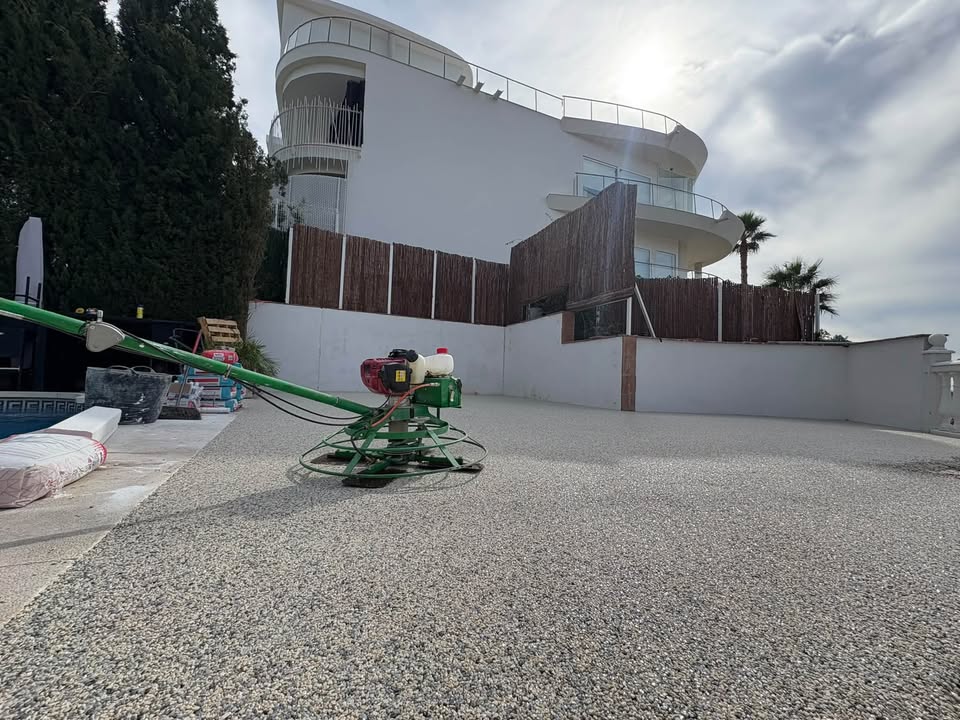
Laid on a proper base.
Infi-Rox jobs from our installers.
More in the Infi-Rox Binder guide series
Questions we get asked
How dry does concrete need to be?
Below 6% moisture, with pH below 10. Never lay onto damp or green concrete.
What falls does a SuDS base need?
Falls of 1:60 to 1:80, checked at the sub-base and capping layers.
How deep is the Type 3 sub-base?
125 mm as standard, increased up to 225 mm where sub-soil permeability is a concern, compacted in 75–100 mm layers.
Can I lay in the rain?
No. Don’t start if rain is forecast, and never lay in rain, on standing water or in freezing conditions.
What causes loose stones?
Not enough binder, poor mixing or poor compaction. Keep to the binder quantities and mix until every stone is coated.
Keep reading
All news & guides One factory, every surface: which Infinity system?Which Infinity system for your project? Pick the surface, from worktops and kitchen doors to floors, walls, driveways, uPVC and furniture, and see the system.26 Nov 2026 · 4 min readRead the guide
 Start a coatings business with InfinityHow to start a coatings business with Infinity Effects: pick your services, train and certify, open a trade account, get found and grow.26 Nov 2026 · 3 min readRead the guide
 How to order from Infinity EffectsHow to order from Infinity Effects: set up your account, build your kit list, check out and choose delivery, with dispatch times and where we ship.26 Nov 2026 · 3 min readRead the guide